





Responsible Product
We ensure that the design, manufacturing, quality control, and shipping of our products meet customer expectations. All products comply with relevant safety and labeling regulations in various countries, such as medical devices. We strive for continuous innovation to collaborate with customers in developing innovative and sustainable technology products. Additionally, we aim to reduce the use of organic solvents and minimize waste generation.

All Business Units
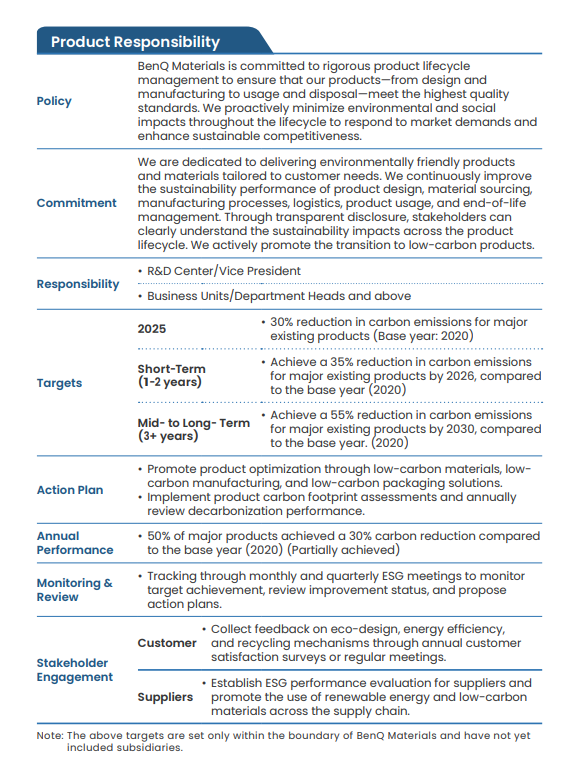
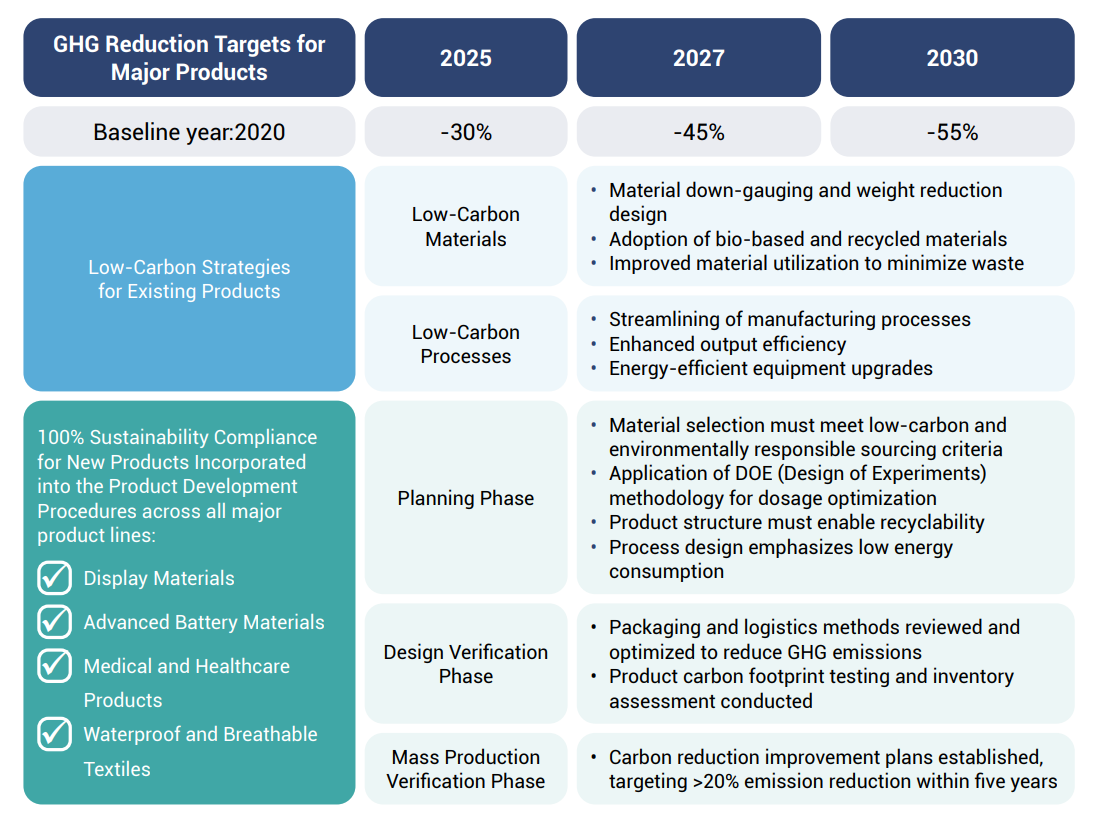
100% of new product developments must comply with internal sustainability criteria
Healthcare Products
Waterproof and breathable textiles
e2cycle: Innovative PET Recycling Technology Transforming Electronic Waste into High-Performance Textiles
Sustainable Design and Innovation of Products
To realize sustainable product value creation, BenQ Materials has formally incorporated the requirement that “100% of new product development must meet the sustainability definition” into the Product Development Procedure and introduced lifecycle thinking covering the design, manufacturing, logistics, use, maintenance, and end-of-life stages. Product design principles integrate circular economy concepts and use an internal sustainability assessment form for itemized review, covering six dimensions: structural optimization, environmentally friendly raw materials, use of recyclable materials, lowimpact components, product packaging reduction, and use safety. Several products have already obtained third-party carbon footprint certifications (refer to Section 5.2.3 Greenhouse Gas Management for details).
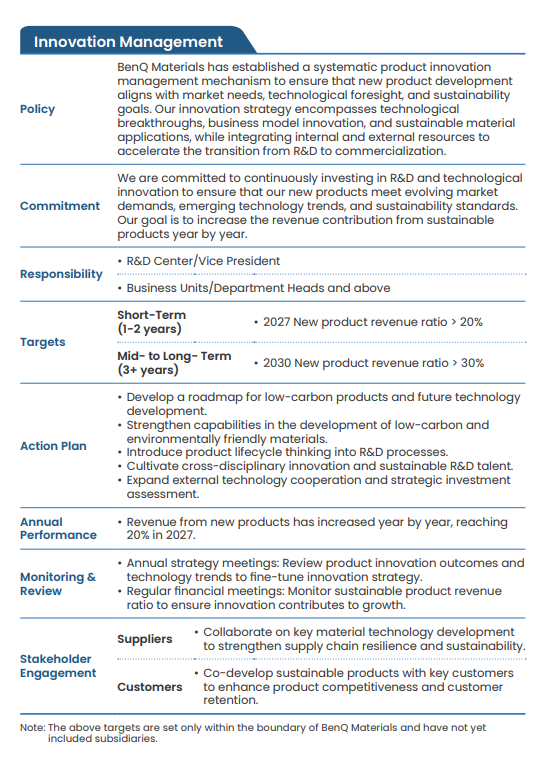
To align the Company’s product portfolio more closely with innovation, the Company incorporates both carbon reduction thinking and innovation thinking during the R&D stage, and uses “percentage of revenue from new products” as a key management indicator. We have established medium- and long-term targets: revenue from new products shall account for at least 20% of total revenue by 2027 and exceed 30% by 2030. For the achievement status of product carbon reduction and the percentage of revenue from new products, please refer to Section 2.1.3 Sustainable Developmen
• Structural Optimization
• Low Environmental Impact Components
• Use of Environmentally Friendly Raw Materials
• Reduction in Product Packaging
• Incorporation of Recyclable Materials
• User Safety and Health Considerations
Sustainable Design
| Aspect | Design Principle |
|---|---|
Design |
Structure optimization |
| Better Materials | |
| Recyclable Materials | |
| Low-impact elements | |
| Product safety | |
Manufacture |
High-Performance Manufacture |
Logistics |
Green Packaging |
| High-Performance Delivery | |
Use Maintenance and Repair Scrap |
High-Performance Products |
| Product Life | |
| Product maintenance rights | |
| Circular Economy (closed loop) |
For the complete sustainable design content of display materials,Advanced Battery Materials,Healthcare and Nursing Products and Waterproof and breathable textiles please refer to the Sustainability Report P.67-71.
Sustainable Product Design Training
BenQ Materials provides sustainability- and Green Product-related training to R&D and product development personnel. In 2025, training topics included Green Product hazardous substance management and restricted substance requirements such as REACH and CMR, strengthening R&D employees’ awareness of environmental and chemical substance management requirements in product development and supporting the integration of sustainability considerations into the new product development process.
| Training Program | Sessions | Participant Attendances | Course Duration | Total Training Person-hours |
|---|---|---|---|---|
| GP Hazardous Substance Management – 2025 Annual Training | 1 | 40 | 1 hr | 40.00 |
| GP Hazardous Substance Management (Green Product) | 1 | 2 | 1 hr | 2.00 |
| Restricted Substances – REACH & CMR | 1 | 1 | 3.65 hrs | 3.65 |
| Total | 3 | 43 | 5.65 hrs | 45.65 person-hours |
Sustainability Topic Management Approach