






Friendly Workplace
Employees are important assets to the company, and our main goal is to create a friendly workplace where employees can work with peace of mind and have opportunities for growth and development. We highly value the voices of our employees and maintain continuous communication through diverse channels. Our continuous efforts aim to create a friendly workplace with a focus on employee well-being.

Average Training Hours
for Indirect Employees in 2025
The closure rate of employee complaint channels in 2025
Key talent retention rate
in 2025 reached
Manpower Overview
BenQ Materials strictly complies with the Company’s Human Rights Policy and Human Rights Implementation Guidelines. Upholding fair, impartial, and open selection principles, the Company actively creates a diverse, equitable, and inclusive (DE&I), friendly, and vibrant workplace environment. We fully comply with labor regulations at each operating site, as well as international standards such as the United Nations Universal Declaration of Human Rights (UDHR), the United Nations Guiding Principles on Business and Human Rights (UNGPs), and the Responsible Business Alliance (RBA), and are committed to protecting employees’ human rights and fundamental labor conditions.
In its employment policy, BenQ Materials firmly eliminates any differential treatment based on gender, race, socioeconomic status, age, marital status, family status, or other factors. The Company is committed to providing a zero-harassment work environment and ensuring that all talent enjoys equal and fair opportunities at every stage, including recruitment, appointment, compensation, benefits, training, performance evaluation, and promotion. The Company also specifically implements its commitments to equal remuneration for men and women for work of equal value, equal pay for equal work, and a reasonable living wage.
Relevant principles and requirements have been clearly incorporated into the Company’s Corporate Business Responsibility Code of Conduct Management Regulations and Direct / Indirect Personnel New Hire Management Regulations. These serve as important bases for institutionalized implementation of human rights protection and fair employment principles. The Company also regularly reviews and updates relevant management regulations and integrates human rights due diligence procedures to ensure that system content remains aligned with international trends and local regulations, continuously optimizing human resource-related systems. Through deepening and internalizing its systems, BenQ Materials establishes an open and supportive work environment, thereby improving organizational efficiency and overall sustainable competitiveness.
Employee Statistics
As of December 2025, BenQ Materials had a total of 3,419 employees worldwide, an increase of 206 employees compared to 2024.
The main reasons for the increase in headcount were as follows:
- In mainland China, the Suzhou Plant added a total of 111 employees due to increased production demand.
- In Taiwan, the Yunlin Plant in Yunlin added a total of 79 employees in response to expanded production scale.
- Taiwan: 2,358 employees, an increase of 72 employees compared to 2024.
- Mainland China, including the Suzhou Plant and Wuhu Plant: 955 employees, an increase of 117 employees compared to 2024.
- Vietnam: 106 employees, an increase of 17 employees compared to 2024.
At the Wuhu Plant and Suzhou Plant, in response to market order fluctuations and seasonal capacity demand, the Company flexibly deploys fixed-term contract employees and dispatched workers to support standardized production line operations such as quality inspection and packaging, thereby maintaining production flexibility. In Vietnam, in accordance with local labor regulations, employees are hired under fixed-term contracts during their first three years of employment. To establish stable labormanagement relations, the Company converted employees who had completed three years of service in 2025 to non-fixed-term contracts for permanent employment, resulting in a significant decrease in the number of temporary employees in Vietnam to 63 compared to 2024. In Taiwan, the Company flexibly used a total of 41 temporary workers in response to production or specific job requirements.
As of the end of 2025, BenQ Materials had a total of 1,856 non-employee workers, mainly including resident outsourced service personnel and engineering contractors. Resident outsourced personnel include support services such as group meals, security, and cleaning. Based on the actual number of persons providing services, there were 171 such personnel. Among them, cafeteria group meal personnel accounted for the largest number, totaling 57, followed by security guards, totaling 51. Engineering contractors are technical or construction personnel dispatched by external contractors to the plants to carry out various production equipment, facility, or project engineering operations, totaling 1,685 persons.
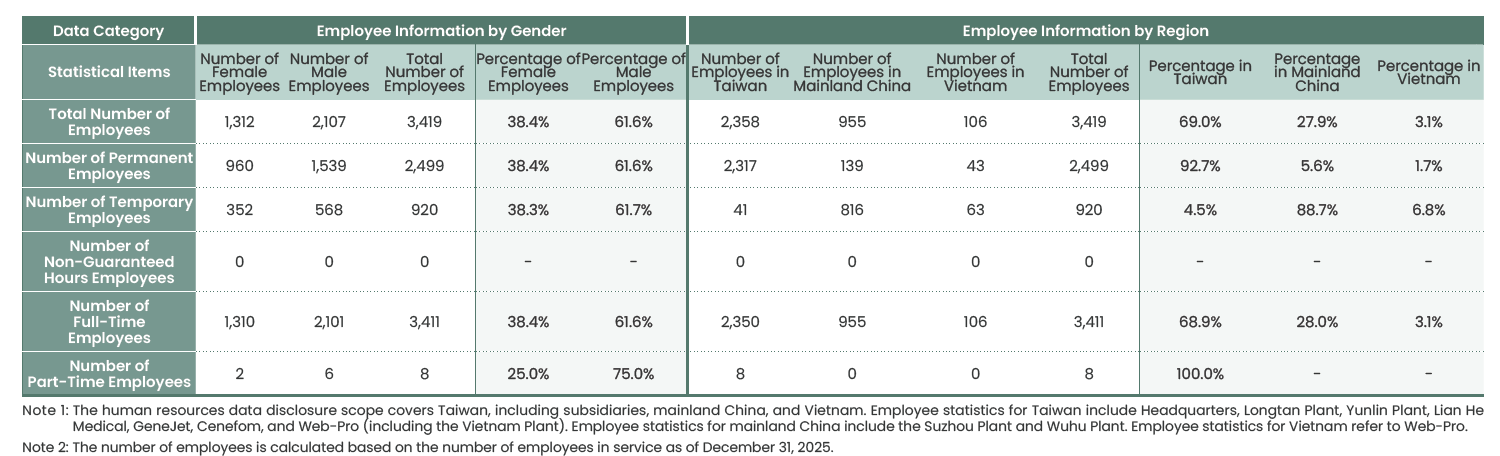
By contract type, there were eight part-time employees at Taiwan operating sites, accounting for 0.2% of all employees, representing a very low overall percentage. Among them, seven were at the Taoyuan Plant and one was at the Yunlin Plant. By gender, there were two female employees and six male employees. The mainland China and Vietnam operating sites currently employ no part-time employees.
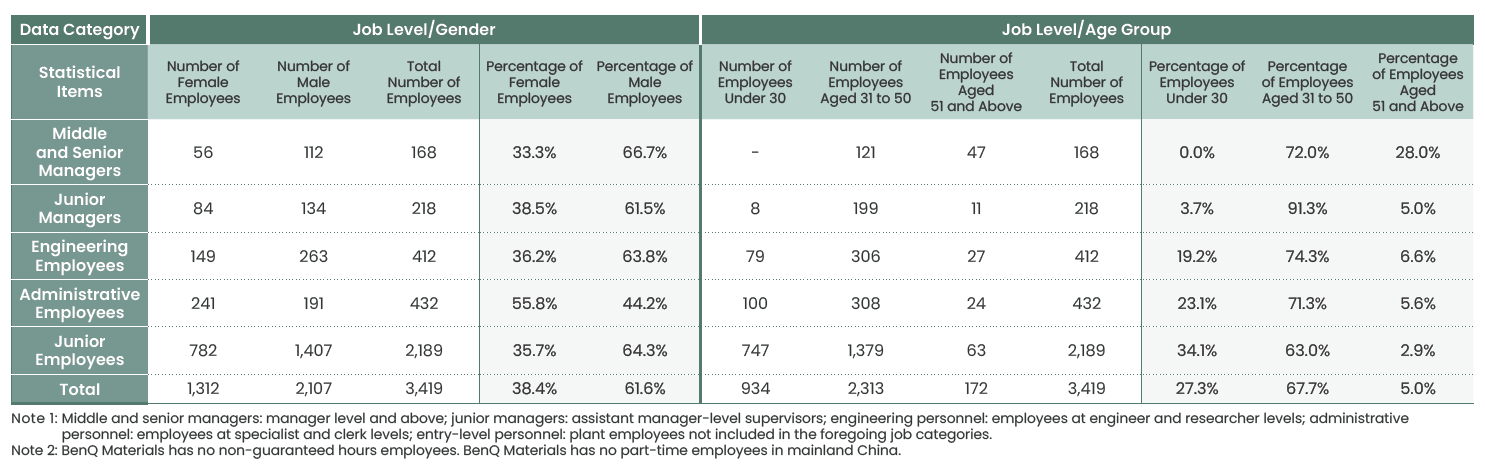
By gender, male employees accounted for 61.6% and female employees accounted for 38.4%. By age structure, the average employee age was 36.5. Employees under the age of 30 accounted for 27.3%, employees aged 31 to 50 accounted for 67.7%, representing the main age group, and employees aged 51 and above accounted for 5.0%.
By job level and job function, female administrative personnel accounted for 55.8%, higher than the percentage of male administrative personnel and the overall percentage of female employees, 38.4%. Female first-line managers accounted for 38.5%, slightly higher than the overall percentage of female employees. Female middle and senior managers accounted for 33.3%, female entry-level personnel accounted for 35.7%, and female engineers accounted for 36.2%, all slightly lower than the overall percentage of female employees.
In revenue-generating functions (Sales, Marketing, PM, and Customer Service, excluding support roles such as HR, IT, and Legal), women account for 52.83% of all management positions (IDL).
The current reporting boundary covers headquarters and excludes subsidiaries and overseas sites.
BenQ Materials' operating and production sites are mainly located in Asia, including Taiwan, mainland China, and Vietnam. The employee structure reflects regional characteristics and is primarily composed of Asian employees. By nationality, Taiwanese employees totaled 1,847, accounting for 54.0%, representing the main composition. Employees in mainland China totaled 952, accounting for 27.8%. Southeast Asian employees also play an important role, including 333 Filipino employees, accounting for 9.7%, and 203 Vietnamese employees, accounting for 5.9%. In addition, the Company actively recruits multinational talent. The remaining 84 employees, accounting for approximately 2.5%, come from multiple countries, including Indonesia, Malaysia, Japan, South Korea, Hong Kong, India, and Ukraine, fully demonstrating the richness and inclusiveness of workplace culture.
In terms of the composition of the senior management team, BenQ Materials actively implements a management localization strategy and is committed to cultivating and promoting outstanding local talent to strengthen the local operating advantages of each site. As of 2025, among senior executives employed in Taiwan, local nationals accounted for 95.5%. At mainland China operating sites, including the Suzhou Plant and Wuhu Plant, Chinese nationals accounted for 76.9% of senior management positions, specifically reflecting the Company's commitment to empowering local talent and promoting inclusive development.
BenQ Materials continues to focus on the employment rights of persons with disabilities and is committed to providing diverse and inclusive job opportunities. In 2025, the actual number of persons with disabilities employed in Taiwan was 21, accounting for 0.89% of all employees in Taiwan. Pursuant to the People with Disabilities Rights Protection Act, the required number of employees with disabilities in Taiwan was 23. The actual number employed was 21, representing a fulfillment rate of 91.3%. For the shortfall, the Company will initiate an internal inventory process and continue to assess job content related to business support and employee services, and design and arrange suitable positions to recruit and employ talent with disabilities, continuing its efforts to promote workplace inclusion.
BenQ Materials pays attention to job opportunities for Indigenous peoples in Taiwan. In 2025, the Company was required to employ 18 Indigenous employees and actually employed 30, accounting for 1.27% of all employees in Taiwan, with a fulfillment rate of 166.7%, exceeding the statutory requirement.
Employee Turnover
In 2025, BenQ Materials had 1,401 new employees, with a new hire rate of 41.0%, an employee turnover rate of 37.7%, and an average recruitment cost of NT$9,800 per employee hired.
The overall annual new hire rate in Taiwan was 32.4%, with the female new hire rate at 34.1% and the male new hire rate at 31.4%. By age group, the annual new hire rate for employees under 30 was 53.1%, significantly higher than other age groups. The rate was 27.5% for employees aged 31 to 50 and 7.5% for employees aged 51 and above. This mainly reflects the Company’s continued expansion in operating scale, which has increased entry-level job openings and made younger employees the main source of new hires.
The overall annual turnover rate in Taiwan was 29.2%, of which the voluntary turnover rate was 28.4%. By gender, the annual turnover rate was 28.3% for male employees and 30.7% for female employees. By age group, the annual turnover rate was 36.5% for employees under 30, 28.2% for employees aged 31 to 50, and 13.1% for employees aged 51 and above. Comparing the number of resignations with total resignations, employees aged 31 to 50 were the main turnover group, accounting for 66.5% of all resignations. Overall, the turnover rate in Taiwan in 2025, 29.2%, was lower than the new hire rate, 32.4%, indicating that the organization’s workforce structure remained in a growth stage.
The overall new hire rate in mainland China, including the Suzhou Plant and Wuhu Plant, was 60.1%, with the female new hire rate at 61.4% and the male new hire rate at 59.2%. By age group, the annual new hire rate for employees under 30 was 98.1%, significantly higher than other age groups. The rate was 41.0% for employees aged 31 to 50 and 0% for employees aged 51 and above. This mainly reflects increased operating demand at the plants, which has driven growth in entry-level factory positions and made younger employees the main source of new hires.
The annual turnover rate in mainland China, including the Suzhou Plant and Wuhu Plant, was 58.0%. The main reasons were a tight local labor supply and the widespread use of short-term dispatched labor and fixed-term contract workers at the plants to support flexible production line adjustment needs, resulting in a significantly higher overall turnover rate. By gender, the annual turnover rate was 57.4% for male employees and 58.9% for female employees. By age group, the annual turnover rate was 92.3% for employees under 30, 39.9% for employees aged 31 to 50, and 85.7% for employees aged 51 and above, the age group with the highest turnover rate.
In Vietnam, the overall new hire rate was 59.4% and the annual turnover rate was 44.3%. By gender, the male new hire rate was 64.1% and the male turnover rate was 46.2%; the female new hire rate was 46.4% and the female turnover rate was 39.3%. By age structure, employees under 30 had a new hire rate of 126.5% and a turnover rate of 111.8%, representing the group with the highest new hire and turnover rates. Employees aged 31 to 50 had a new hire rate of 29.9% and a turnover rate of 13.4%. There were no new hires or departures among employees aged 51 and above.
Note 1: Annual new hire rate = (Total number of new hires during the year/Total number of employees in service at year-end)
Note 2: Annual turnover rate = (Total number of departures during the year/Total number of employees in service at year-end)
Voluntary employee turnover rate
| Year | Voluntary employee turnover rate |
| 2022 | 30.71% |
| 2023 | 17.15% |
| 2024 | 33.3% |
| 2025 | 28.4% |
Overall Turnover Analysis
To accurately understand talent mobility trends and optimize retention strategies, BenQ Materials conducts systematic analysis of reasons for turnover. The statistics show that personal factors were the primary reason for turnover, accounting for 56.3%. These include personal career changes, health considerations, career planning, and family care needs. Work-related factors ranked second, accounting for 22.6%, with work adaptation being the main reason.
Through this data analysis, BenQ Materials is able to gain deeper insight into employees’ potential needs and pain points in organizational management. For work adaptation issues, we will strengthen the accuracy of recruitment matching and the new employee coaching mechanism. For personal factors, we will continue to optimize employee care and healthy workplace programs. The results of this analysis can serve as an important basis for dynamically adjusting human resources policies to improve employee satisfaction and long-term retention.
Analysis and Management of Direct Labor Turnover
To accurately understand turnover trends among direct production line personnel, BenQ Materials has implemented an exit questionnaire mechanism for systematic collection and analysis of turnover data. In 2025, a total of 189 valid questionnaires were collected. Statistical analysis showed that the top three reasons for turnover were, in order: finding other job opportunities, 16.6%; difficulty adapting to the work environment, 13.6%; and a gap between job content and expectations, 13.3%.
Based on data analysis, BenQ Materials launched corresponding optimization measures to improve workforce stability among entry-level personnel. These include optimizing pre-employment explanation sessions to ensure that applicants have a full and accurate understanding of the actual operating environment and job content, thereby improving person-job fit from the source. At the same time, suggestions related to difficulty adapting to the work environment are provided to supervisors of each employing unit as a concrete basis for improving on-site management models and optimizing the operating environment. Through the above measures, BenQ Materials reduces gaps in understanding, creates a more friendly operating environment, enhances direct labor employees’ willingness to stay, and strengthens entry-level production capabilities.
Regular Dialogue with Migrant Workers
BenQ Materials places great importance on the voices of foreign employees and firmly believes that smooth communication channels are key to improving work adaptation and reducing turnover. In 2025, the Company regularly held a total of eight migrant worker forums, building a multi-party dialogue platform that included Company management, human resources, and agency partners.
The forums focused on practical issues of greatest concern to migrant workers. Through in-depth face-to-face exchanges, the Company made concrete improvements to dormitory environments and optimized related living facilities based on suggestions raised by migrant workers. Discussions were also held on work management systems and the suitability of on-site work content. Through regular listening and timely feedback, the Company effectively resolves potential communication barriers and significantly enhances foreign migrant workers’ sense of identification with Company policies and sense of belonging.
2025
Objective
Key talent retention rate
The closure rate of employee complaint channels
Percentage of female supervisors at the section
level and above
2025
Outcome
Key talent retention rate
The closure rate of employee complaint channels
Percentage of female supervisors at the section
level and above